
Assignment Guidelines
Resource Readings from NFG (These readings will help you complete the assignment)
- NFG, Annotated Bibliographies, 188 to 196
- NFG, Summarizing, p. 33-35; Reading Critically, p. 26 to 29 (Considering the Rhetorical Situation, Identifying Patterns)
- NFG, Evaluating Sources, p.469-472; Synthesizing Ideas, p. 473 to 477
- NFG, Developing a Research Plan, 435 to 440;
- NFG, Keeping a working bibliography, p. 441 to 444
- NFG, Finding Sources, p.445 to 455; Single Subject Index and Databases, p. 460; Searching the Web, p. 462 to 463
- NFG, Rhetorical Situations, p. 55 to 70.
Overview
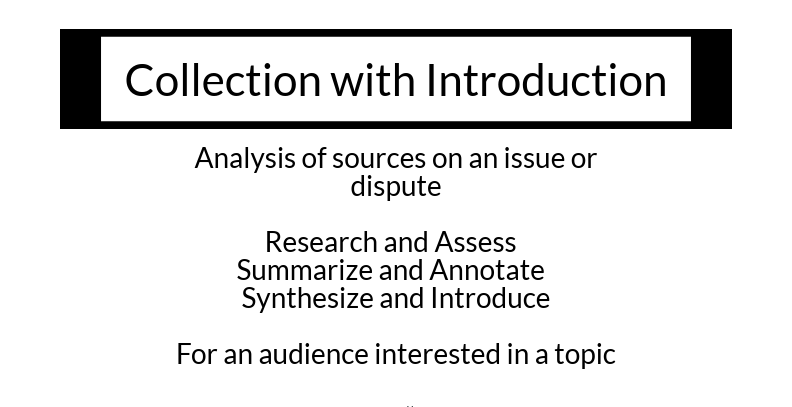
The Conversation Collection with Introduction is an informative text with a point of view. It’s created for readers who are interested in understanding a topic or issue. It’s a form of Annotated Bibliography as described in Norton Field Guide (see the reading above). The Conversation Collection with Introduction also begins the long project of the semester. You’ll produce other texts to go along with it. In fact, your classmates will be among the readers– one may use your bibliography to complete other assignments. It will have an introduction that introduces us to the scope of the collection and five entries. Each of these entries are Evaluative Annotations. For examples, see NFG p. 190 to 191.
Choose a Topic
One of the learning goals of the project is to learn how to focus your topic through research. You’re looking for a problem that requires a solution or an issue in dispute. To start, I’ll share “launch” reading through RefWorks (a tool we’ll be using for research). The topic were chose because they’ve been in the news recently and represent areas that are part of national life upon citizens and their representatives will have to decide. Each of the issues can be approached from several different angles. Although I am willing to consider another topic, you’ll have to discuss it with me and get it approved. Within each of these topics, however, I hope you’ll find angles that satisfy interests you may have. For example, many can be approached from policy angles, scientific and technological angles, and other areas of study. The purpose of the process of topic selection is to learn enough about it to be able to narrow a topic.
- DACA
- El Salvadoran Deportations
- The Cannabis Industry
- School Discipline Reform
- Opioid Epidemic
- Universal Basic Income
Design
The document has two parts, an Introduction which states the scope of the collection and the Collection itself.
Format of Document
- Use MLA Format for citations, headings, page numbers and margins.
- 12 point type, Times New Roman Font
- Title: Centered two lines after the heading, underlined; The title should put the issue you’ve investigated in the form of a question.
- Introduction should start under the title.
- Each entry begins with the citation in MLA format
- The entries should be in alphabetical order
- Paragraphs should be indented
Length
Introduction: 450 to 500 Words
Entries: Each Annotation should be approximately 250 to 350 words
Requirements
Introduction
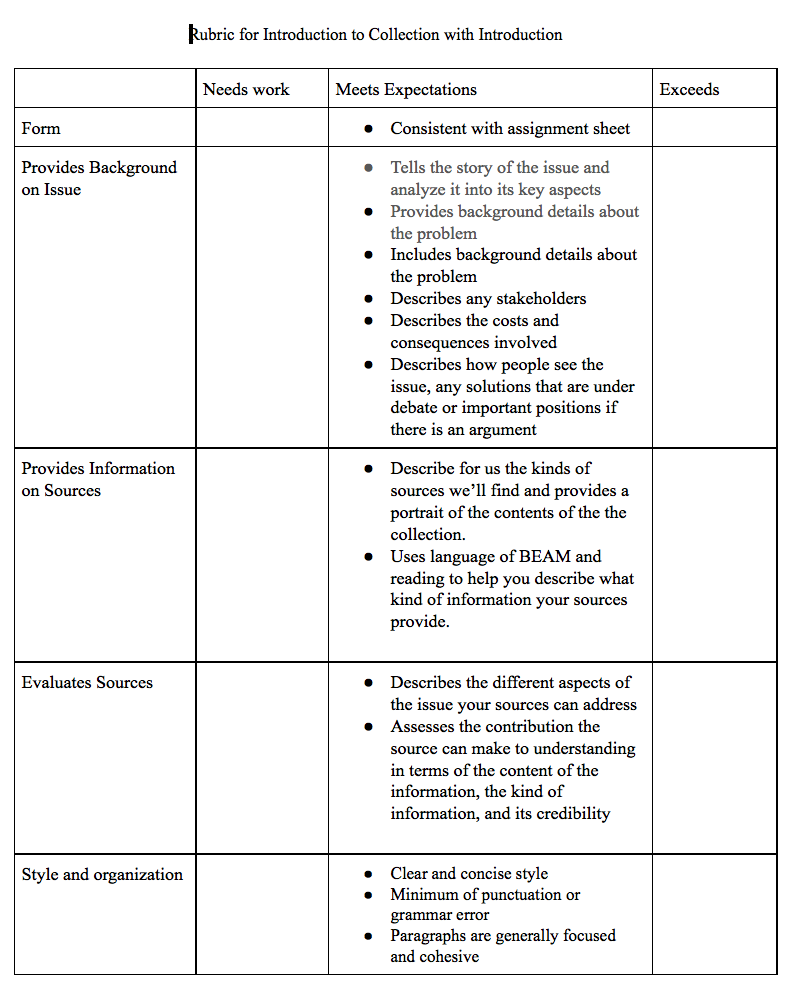
In the first part of the introduction, provide us with a summary of the issue that your sources concern. You’ll find that the chart we made based on the questions on page six of this document will help you find the language for this. Think of this summary as telling the story of the issue and analyzing it into its key aspects so that we are both able to understand the issue and and understand how we might start to learn more about the issue. The summary should include background details about the problem, who the stakeholders are, what the costs and consequences involved in the problem’s resolution (or lack of resolution) are, how people see the issue, what solutions have been proposed, and the major positions involved. The purposes of this first part is to help us understand the dimensions of the issue.
In the second part of the introduction, put the sources into categories and describe for us the kinds of sources we’ll find. Think of this paragraph as a portrait of the contents of the the collection. You’ll use a handout I will give you called BEAM to help you describe what kind of information your sources provide. Your portrait of your sources will be like the categories in your visual essay and will help us understand how the parts fit together to form an understanding of the aspects issue.
Entries (for Examples, NFG, p. 190-191)
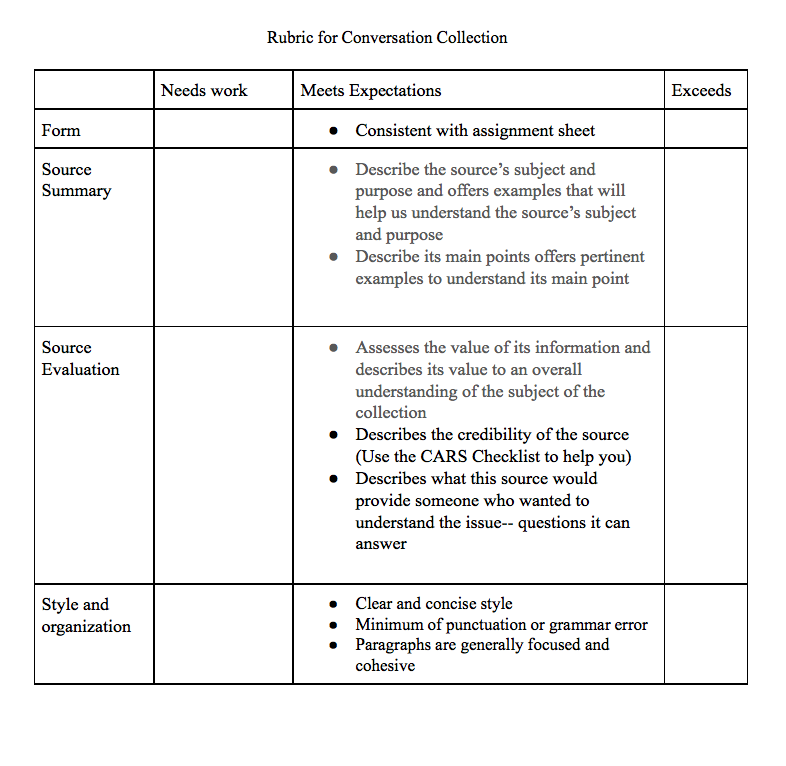
Each of the entries in the annotation will be an “evaluative annotation”. As described in the NFG, evaluative annotations” describe a source and can offer an opinion on the source. Your annotations will describe the source, then assess its value for someone who is researching the topic. In class, we will analyze two annotations to learn the patterns of organization you should use. In general, the annotation should do the following
- Describe the source’s subject and purpose
- Offer examples that will help us understand the source’s subject and purpose
- Describe it’s main points
- Offer pertinent examples to understand its main point
- An evaluation of the source that describes the value of its information
- An evaluation of the source that describes its value to an overall understanding of the subject of the collection
Assignment Rubric: Introduction
Assignment Rubric: Entries
Checklist
Checklist: Taking Stock
Used MLA format for
- Margins
- Heading
- Line Spacing (double spaced)
- Title
- Page Numbers
Type Size and Font
- Times New Roman, 12 Point Type
Used correct organization for assignment
- Sections in the correct order
- Headings correct
- Title as specified in the assignment document
Edit
- Checked responses against the assignment sheet to be sure tasks are complete as directed
- Revised sentences and paragraphs to make sure ideas are clear to a reader
Proofread
- File correctly named as per the instructions in the course guide found on the course website
- Checked for typographical errors, misspellings, missed words, punctuation errors, etc.
- Made sure heading was correct
- Made title is correct, as per MLA and assignment guidelines
- Made sure page numbers are to the left and Times New Roman, 12 point
Submission
- Printed a copy of the document and placed it in the appropriate section of notebook for the class when the document is due
- Upload the document by class time on the due date into your submissions folder
- Uploaded into the correct assignment folder as a word document or google doc (not a pdf)
 robertdanberg