
Overview of the Class
Rdanberg
Three Ways of Looking at the Class
Our class is built around inquiry and argument. You will identify a dilemma, problem, issue or situation, one that requires a community’s or audience’s attention and compose arguments that change what members of the audience think or do.
By the end of the class, your work will show if you are able to demonstrate why and how the dilemma, problem, issue or situation requires audience attention, if you can take a position and support claims based on evidence the community respects, if you understand and can respond to objections to your position and if you are able, in a clear and organized way explain details and background to dilemma, problem, issue or situation. You will learn to research and write arguments, and produce three final texts for submission in a portfolio, an annotated bibliography that establishes common ground on the dilemma, problem, issue or situation, an argument essay for an academic audience, and multimedia persuasive essay. The differences between how you write each of these, and, in particular, how the last two, will an important part of our class.
You might look at the class in three ways, as a set of documents submitted in a final portfolio, as the outcome of a process of inquiry, or as a series of steps in a process of research and writing.
A Set of Documents Submitted in a Final Portfolio

The Outcome of a Process of Inquiry

A Series of Steps in Process

How We Start: Identify a dilemma, problem, issue or situation, one that requires a community’s or audience’s attention and compose arguments.
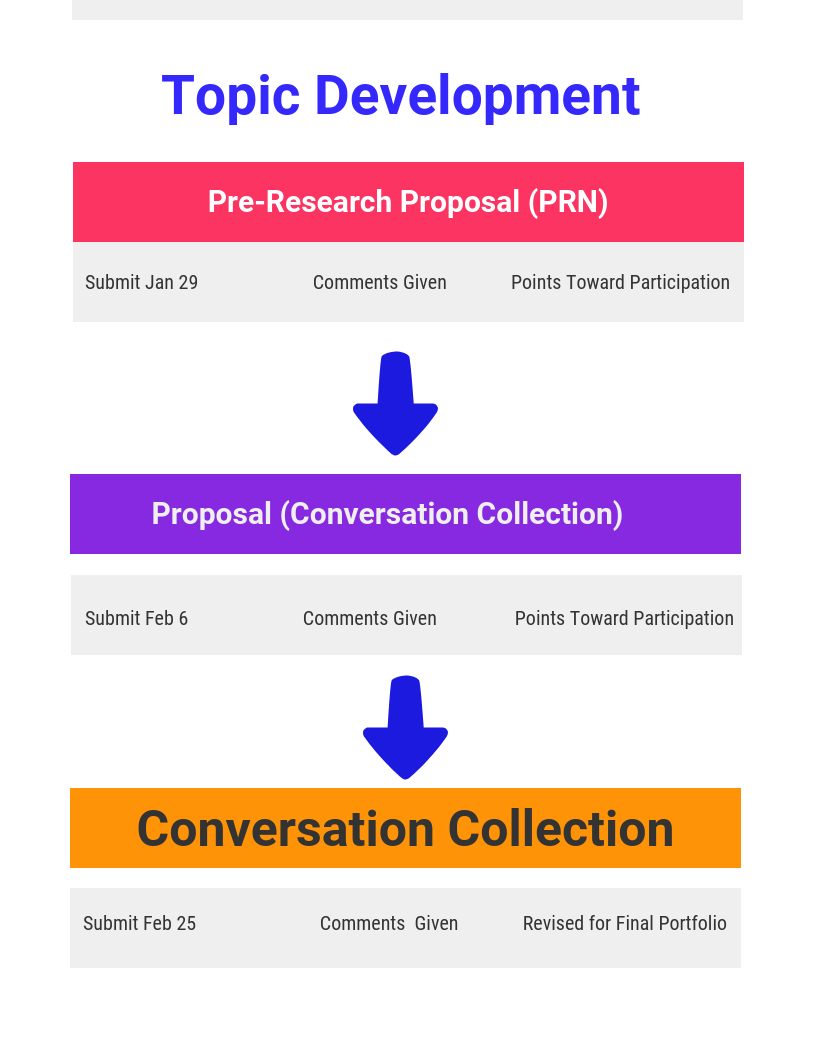
identify a dilemma, problem, issue or situation, one that requires a community’s or audience’s attention and compose arguments that how members of the audience think or what they do.
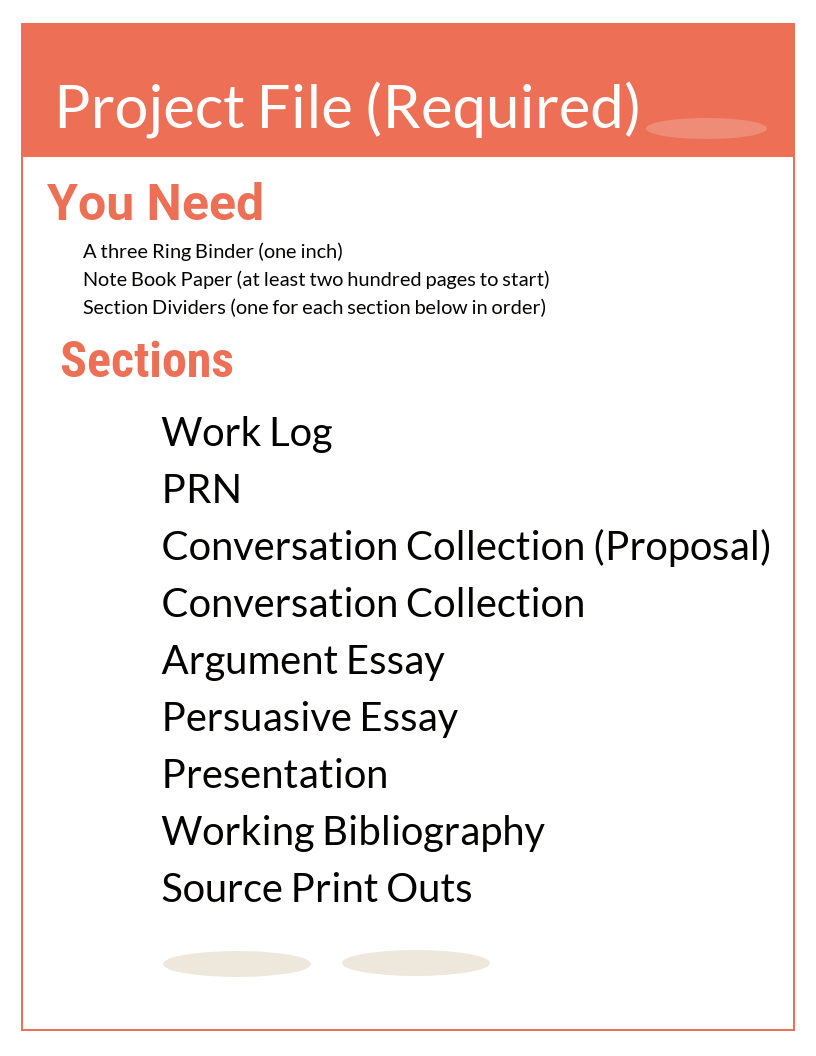
Create Your Project File


Feb 5 Instruction Manual Example
Below, you’ll find three parts: the original instructions, a tutorial, and an example of an annotation based on the technique in the tutorial. The example using The Core of Your Argument: Reasons and Evidence/Supporting Claims (This links to the folder where you’ll find the sample reading I am annotating). I’ve included the instructions here so you don’t have to scroll back and forth.
Instructions (Also linked through our calendar)
Definitions
We’ll be using the following terms as part of our “topic vocabulary”. These terms are scattered through the readings– define them as you find them. You may discover, in your reading, that a term or idea is defined once, then elaborated on elsewhere. Define it everytime it appears in a reading. Practice paraphrase. Note page numbers where you find your information. Quote selectively– do your best to put things in your own words.
- Destabilizing Condition for a Pragmatic Problem
- Cost of a Destabilizing Condition in a Pragmatic Problem
- Destabilizing Condition for a Conceptual Problem
- Cost of a Destabilizing Condition in a Conceptual Problem
- Consequence of a Conceptual Problem
- Practical Cost
- Conceptual Consequences
Application
Use the concepts from the reading and write a brief example that applies the concept to the linked article: Why Are We Still Teaching Reading The Wrong Way. Feel free to follow any of the links in the article that might give you ways to think about.
Note Taking Tutorial
To create your annotation, you might begin with brief notes of your own in your notebook, then complete the annotation assignment. Below is a brief discussion of my own process, followed by an example of an annotation. You don’t have to follow my steps– I will explain how and why I use them in the recording below them.

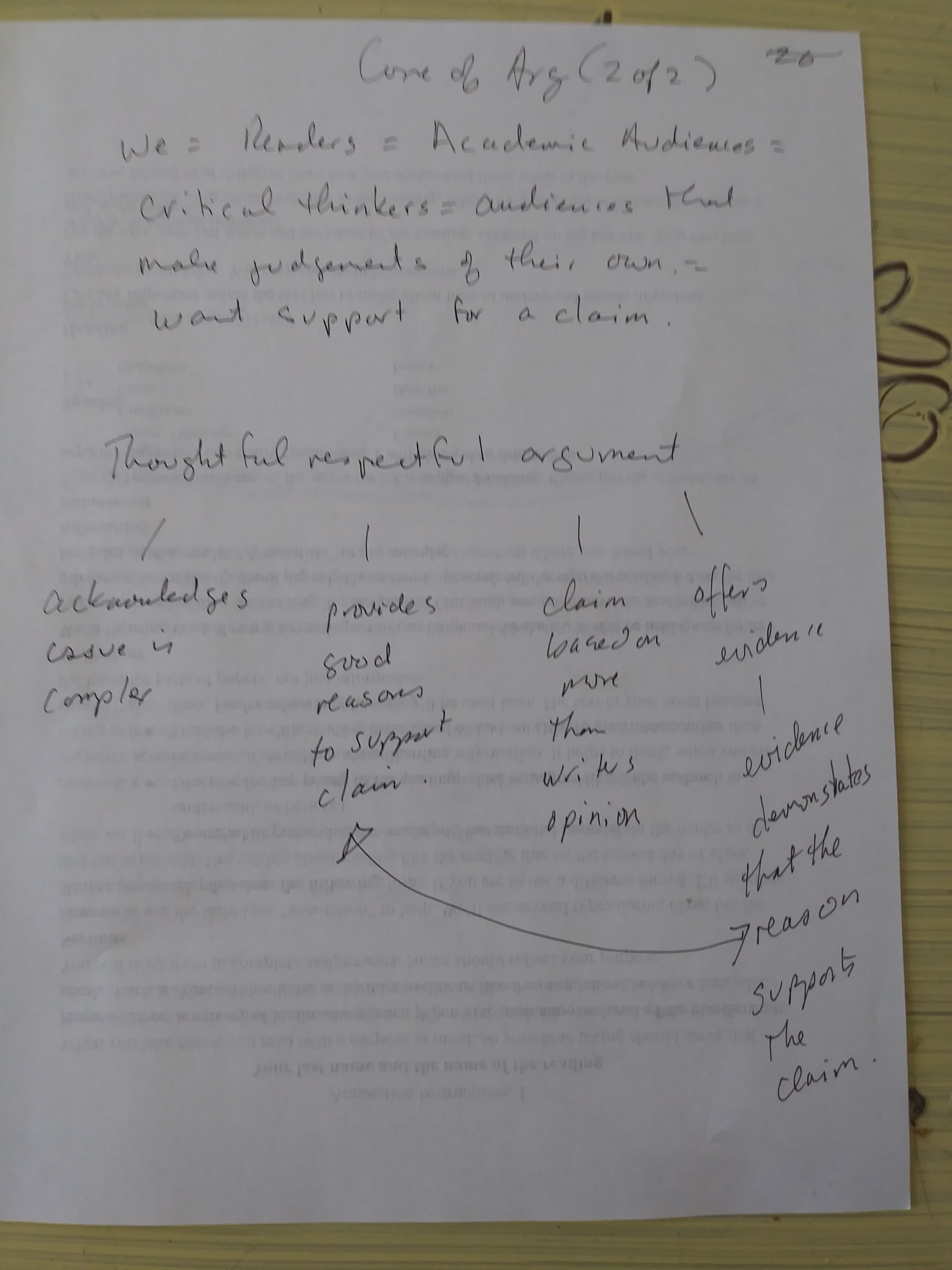
Based on the notes above, I wrote the following annotation based on the instructions.
Core of Argument: Reasons and Evidence
Summary
The writers describes two kinds of authors of an argument. One kind of author’s views the audiences as one that will accept and agree with a claim even if we don’t provide evidence. The second kind expects that the audience will judge the claims the author makes and test the claims and the evidence. Credible claims are supported by reasons, evidence, and supports of evidence. The writer organizes those three things so that the audience can understand how they are connected. According to these authors, a thoughtful and respectful argument treats issues as if they are complex, offers solid reasons, offers claims that are based on more than just opinions, and provides evidence that supports the claims the writer makes.
Definition:
Academic audience: critical thinkers who make their own judgements and want evidence and reasons that they can test to support claims.
Credible claim: a claim supported by reasons, evidence, and supports of evidence that the audience can test and judge.
Application:
Emily Hanford, in Why Are We Still Teaching Reading the Wrong Way, claims that educational research shows that a systematic phonics approach is the most effective way to teach reading and that teacher education programs do not use this information when they train teachers. She offers evidence and reports of evidence, including studies and the testimony of teachers and professors in education schools. However, she does not offer evidence that might counter her claims or qualify them. I can see how she connects reasons, evidence and support of evidence to to support her claim. I would want to test her evidence, however, by learning more about what it means to “read at the basic level” and also to learn more about justifications for teaching reading in ways other than phonics instruction.
 robertdanberg