
Introduction to Today’s Work
For the last two weeks, you’ve begun a process that involves looking at how you get work done and working toward a project goal.
You’ve adopted some tools to help you set goals, break them down into actions you can completed, monitor your progress and work habits, and envision your time, week by week, so that you can schedule when you’ll work.
You’ve created a project notebook so you have a central place to review what you’ve accomplished over the past week and to set goals for the next week.
You’ve begun to investigate how academics get work done to see if there are approaches you can adopt to improve how you work towards your goals.
Today, in class, we begin a new phase of your work.
I want you to consider February 7 through April 24 to be a twelve week project period. Today, you’ll decide on one to three goals you would like to achieve by April 24. If you decide on more than one, you’ll designate one to be the priority.
On April 24, we’ll review what you’ve accomplished and on the last day of class, we’ll go through the process of setting goals for the next twelve week period: the summer.
By limiting the project period, you can see very clearly what steps you need to take to finish a phase of your larger project. You can then more easily set weekly goals, choose how to accomplish those goals, monitor and review your progress.
Hopefully, this approach will help you adapt to the contingencies of each week, and be flexible as new information comes in about your project.
Below are the steps you’ll follow, with examples from my own work. I am using the same tools you are and following the same project period.
First though, it’s time to Review the Previous Week and Reflect.
Review and Reflect
Review the “Project List” and “Next Actions” for the projects you chose.
Cross things off your Next Action lists. Add to them.
Have new Projects emerged? Add to your Project List.
Review your log. Review your journal if you’ve been keeping one.
Now, in your log, write a reflection. Assess how you’ve used time over the last week. Were you able to do the work you’d intended? What tasks have you completed?
Be honest, but gentle with yourself.
You chose to do the work of this class so you could learn some new techniques to improve your goal setting and goal achieving.
You are in the process of learning how to incorporate those techniques into your life.
If you found that you didn’t get quite as much done as you’d hoped, or perhaps didn’t do any of it at all, that you didn’t keep a log, that you didn’t set a schedule, simply note what you did do, and think about what might have been an obstacle to your completing the work you intended.
Step One: Choose Your 12 Week Goal
Since you’re learning this process, I think you should think of the process as one that will help you think through what you’ll decide. You’re creating a draft that you’ll revise. In our last step, I’ll show you how you can write up what you’ve chosen on a single sheet you’ll return to next week.
Look over your project lists and the priorities you’ve set.
It’s likely that you’ve broken your big goal– say, complete my dissertation– into several smaller projects, each with actions that have to be taken to complete them. You may be working on these over the next six to eighteen months.
Among them, though, are one to three that you can focus on over the next twelve weeks. These are priority projects you want to devote your scheduled time to, the ones that you’ll use your next actions lists to plan week by week.
These are the ones I’ve chosen
- Complete Detailed Outline of the Book
- Spend two hours per week submitting poetry for publication
- Learn the steps necessary to find an agent for the book
- Complete a draft of a thirty page section of the book
By the end of twelve weeks, I want to be able to see the results I’ve described above. Notice that two of my goals are written products (an outline and a draft), but one will provide me with information I need to publish the completed work, and one concerns doing what’s necessary to publish already completed work.
I know that to move forward, I need to create an outline. And a draft of thirty pages will help me share my concept of the book with others. These concrete steps will lay the foundation for what comes next.
By the summer, I want to start the process of getting an agent. I don’t know how, but I know the outline and the thirty pages will be part of it, so whatever I learn– and twelve weeks is plenty of time to learn it– I’ll be in a good position to use that knowledge to set my next goals.
Finally, I have poems that are written and ready to submit. Getting them into the world is more of a chore than anything else. Any publication contributes to my writing goals.
I chose those goals based on knowledge of my own time and work habits. A mix of creative work, like drafting, a work that involves reading, consulting with people, and hitting “send” is a good blend that can keep me busy when I have “A” time and “B” time, to use Zerubavel’s categories for times you do work that requires concentration, and when time is short and your energy is low.
So, pick your goals for the next twelve weeks.
You may only have one, because the tasks involved are complex and clear. You may have more. Try to choose no more than three, at first– certainly no more than five. Remember that we will be reviewing your choices each week. Make sure the outcomes is clear though.
Plan Your Weekly Goals
I’ve decided what my twelve week goals are.
On April 24 I want
- A complete detailed outline of the book,
- To have spent two hours per week submitting poetry for publication,
- Learned the steps necessary to find an agent for the book,
- And completed a draft of a thirty page section of the book.
Each of these goals are on my Project List, and each of them has a list of Next Actions.
The idea here is to think both in terms of actions that will move me, day by day and week by week toward a goal so that I have a better sense of what to do.
In the fall, I had only one goal. All summer, I’d taken notes for the book, listing topics and making a preliminary outline. When fall came, I really had only two goals: translate my notes into topics for writing, and generate text based on those topics and notes. My time was my own. Each day, I toggled between them.
Now there is more to do, and I must be more strategic about the time I have.
So, I review the time I have this week by looking at the week ahead. I have less uninterrupted time than usual because of meetings with students, although I have two days at I can work at home. I am teaching new classes, which requires more planning right now, which will lessen in a week or two. I’ve found that I work best in the morning. If I put off writing until the afternoon, it can get bumped out of the way, whereas no matter when I work on teaching prep or work related projects, the work gets done. So I want to find good time this week for work related to the book. But there will be a lot of “B” time this week.
I’ve decided that this week, my goals are
- Spend 6 hours Reading and Annotating Fall Draft
- Mock up chapbook sections one, two and three
- Submit 250 to 500 words of book for Writing Group
- Contact Rebecca Barry about consultation
To achieve my outline/chapter goals, I have to read the messy draft from the fall. I’d like to spend six hours on it spread out over he week. Right now, I really don’t know how many pages I can get through in an hour. Every week I meet with a writing group. I’ll choose 250 to 500 words from the draft to bring.
To maintain my publishing goals, I want to take poems I’ve written and assemble them into a chapbook, which is a short book of 21 to 28 pages. That means printing them out and organizing them. Note heavy work– just busy work putting together the draft I’ll proofread and submit. Next week, I’ll probably spend my poetry time identifying contests to submit. Finally, my “learn how to find an agent” goals will be satisfied by reaching out to the person I am going to consult with about the process. That will consist of a quick email and, perhaps, a reply.
Notice that some of these tasks require concentration, while others don’t. Some require very little time to complete. The next step will be to decide when, during the week, I’ll set aside time to work on these weekly next actions that will lead to my twelve week goal.
Look at your next action lists. Consider your twelve week priority goals. Think about how you work and the time ahead.
What actions do you want to take this week? Remember, an action may simply be time devoted to a task. I have to read that draft. I need to make time to do it. What do you want to do this week?
What Kind of Behaviors Help me Achieve my Goals
It is hard to make time, but Zerubavel and Silvia agree, a schedule of some kind makes it more likely that you’ll complete your task.
Each of us, though, has a different relationship to time, and even to the idea of making that kind of appointment. As I mentioned earlier– I always know I’ll make time to prep for class or read papers. Right now, it’s 9:57 pm on a snowy Thursday evening. I know that tomorrow may be a “snow day”– or that I may not be able to travel because of snow (I live an hour from work), while some or all of my class will be waiting for me.
This new class is an experiment I want to succeed and tomorrow is an important day: The beginning of our twelve week goal period! I don’t want to miss it. So what will I do?
This– write up my notes so that the class can “try this at home”.
That’s my point: work for work gets done, while work with goals that seem distant, and intermediate deadlines that seem soft, get easily pushed and, for lack of a better word “de-prioritized”. There are many reasons for this– work is work after all. But also, we are steeped in the tasks we need to do. The come to mind, routines and habits and due dates.
So it can help us- those of us who resists schedules– to think about the tasks or actions we need to take (or weekly goals), and then to think: when can I do that? That, as oppose to, “When will I work?” and “Now, what should I do?”
In either case, I have to think: what kind of behavior leads me to complete those goals. What do I do that gets me out of my own way?
What we have done so far is this:
- Decided on twelve week goals (rather than, say, a year). Completing those goals will move us toward the big goal.
- We’ve decided on our goals for the week by looking at the next actions we’ve identified for each of them.
- We’ve thought about the week ahead, the time we have, and the kinds of actions we could undertake this week.
Here are my weekly goals– the actions I want to complete this week.
- Spend 6 hours Reading and Annotating Fall Draft
- Mock up chapbook sections one, two and three
- Submit 250 to 500 words of book for Writing Group
- Contact Rebecca Barry about consultation
To get this work done, I have to do the following
- Identify morning sessions for reading fall draft (If I don’t designate specific mornings for this work, I won’t get it done)
- Leave home to read the the fall draft
- Have my materials ready to annotate the draft and organize it
- Enter how many pages I get through in my log and note what I found
- Pick out times at home when I can print- preferably weekend afternoons
- Immediately after printing, put the poems in a folder with blank paper so I can do the mock up
- Wake up early on Saturday to type and printing writing group work
Decide on My Schedule
I looked over my grid for the week, with its student appointments. My daughter is going on a week long trip. I want to go out to dinner with her one night and she may need to do some shopping. I have prep to do, but I have two days at home and two clear days this weekend, with chores and other commitments.
I’ve told you how I’m better in the morning, will always get my prep done, need to do some things outside of the house, and can do some things in the house. (I probably can get poem printing done while making dinner!)
So I decided that I would try this:
- Saturday, 2/10 7am to 8:30am Type up group work; 12 to 2 Reading and Annotate Fall Draft (Library)
- Sunday, 2/11 Dinnertime Print Chapbook poems (Home)
- Tuesday, 2/13 9am to 11am Read and Annotate Fall Draft (Gimme); Call RB
- Thursday, 2/14 9am to 11am Read and Annotate Fall Draft
- Thurs, 2/14 7pm to 8 pm Storyboard Chapbook Material
A trick I’ve learned is that the important thing is to get the task done. I look at each day, think about what’s ahead, and if I need to do, I switch around my schedule.
Writing It Up
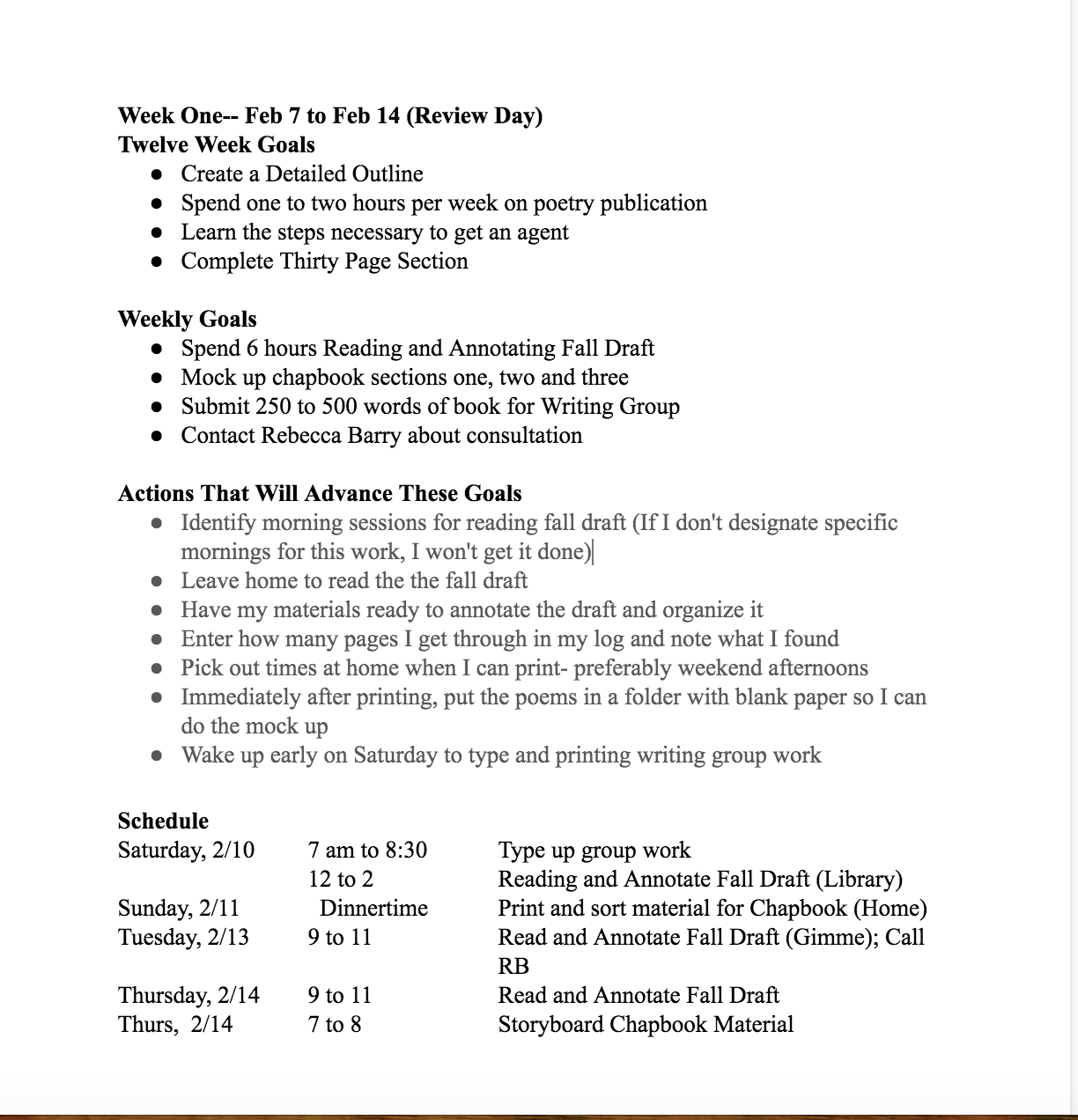
After you’ve worked out what your week will look like, try writing up your week on one page. It might look like this:
Week One– Feb 7 to Feb 14 (Review Day)
Twelve Week Goals
- Create a Detailed Outline
- Spend one to two hours per week on poetry publication
- Learn the steps necessary to get an agent
- Complete Thirty Page Section
Weekly Goals
- Spend 6 hours Reading and Annotating Fall Draft
- Mock up chapbook sections one, two and three
- Submit 250 to 500 words of book for Writing Group
- Contact Rebecca Barry about consultation
Actions That Will Advance These Goals
- Identify morning sessions for reading fall draft (If I don’t designate specific mornings for this work, I won’t get it done)
- Leave home to read the the fall draft
- Have my materials ready to annotate the draft and organize it
- Enter how many pages I get through in my log and note what I found
- Pick out times at home when I can print- preferably weekend afternoons
- Immediately after printing, put the poems in a folder with blank paper so I can do the mock up
- Wake up early on Saturday to type and printing writing group work
Schedule
- Saturday, 2/10 7 am to 8:30 Type up group work
- 12 to 2 Reading and Annotate Fall Draft (Library)
- Sunday, 2/11 Dinnertime Print and sort material for Chapbook (Home)
- Tuesday, 2/13 9 to 11 Read and Annotate Fall Draft (Gimme); Call RB
- Thursday, 2/14 9 to 11 Read and Annotate Fall Draft
- Thurs, 2/14 7 to 8 Storyboard Chapbook Material
 robertdanberg